


Neck and Head Scarves: Guide to the Best Fabrics and Sewing Tutorial
Publicado el 26 March, 2026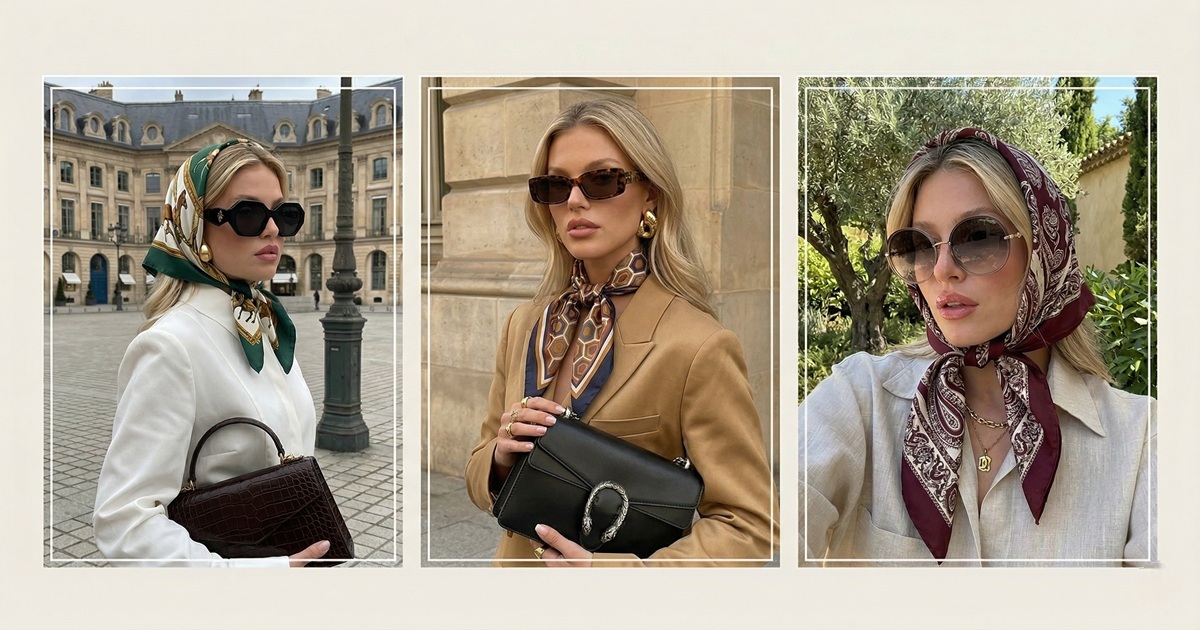
Scarves are the most versatile accessory in a woman's wardrobe. Whether you're looking for neck scarves that add elegance to an office look, or headscarves with a bohemian and chic vibe, the key to success lies in one word: fabric.
Choosing the right fabric determines the drape of the scarf, how it will shine in the sun, and most importantly, how comfortable it will feel against the skin.
Which fabric to choose for your scarves?
If you're thinking of making your own scarves, these are the four winning options for their texture, drape, and durability:
1. Crepe Chine: Timeless Elegance
Crepe Chine is the king of women's neck scarves. It has a slightly granular texture and a very sophisticated matte sheen.
Why choose it:
- It doesn't wrinkle easily.
- It has a spectacular drape.
2. Transparent Chiffon: Lightness and Airiness
If you're looking for an ethereal effect for your head or neck scarves, chiffon is your best ally. It is a translucent and very fine fabric.
Why choose it:
- Ideal for summer events or romantic looks.
- Being so light, it's not heavy or hot.
3. Amsterdam Satin: High-End Sheen
For those who love luxury, this is their option. Amsterdam Satin has a satin side with a vibrant sheen and a body that holds its shape. It is one of the fabrics that most closely resembles silk among our synthetic options.
Why choose it:
- Its feel is soft and silky, ideal for protecting hair from friction.
4. Prada Twill: Strength and Structure
Twill is recognized by its characteristic diagonal texture. It is a fabric with more body, ideal for scarves that require a firm knot or a defined structure.
Why choose it:
- Very resistant and easy to manipulate when sewing.
- It is the preferred option for everyday scarves.
Tutorial: How to make a basic scarf step by step
Creating a standard square scarf (approx. 70x70 cm) is the perfect project for beginners. This size is ideal for wearing around the neck or tying up hair.
Materials needed:
- Fabric: 75 cm of Crepe, Chiffon, Satin, or Twill.
- Matching thread.
- Fabric scissors or rotary cutter.
- Pins and iron.
Steps to follow:
- Precision cut: Cut a perfect square of 72 x 72 cm (this includes a 1 cm seam allowance on each side).
- Ironing is key: Fold 0.5 cm of the edge to the wrong side and iron. Fold another 0.5 cm to hide the frayed edge and iron again. This will create a thin, professional hem.
- Sew the corners: To avoid bulk, you can create "mitered" corners (by cutting the excess tip diagonally before closing the fold).
- Final seam: Sew a straight stitch as close as possible to the inner edge of the hem.
- Master touch: Iron the final seams well so that the scarf has an impeccable drape.
Style tip: If you use Transparent Chiffon, we recommend using a "French seam" or a rolled hem for an almost invisible finish.
Do you need professional manufacturing for your scarves?
If you have a brand or a project in mind and prefer to leave the manufacturing in expert hands, we can help you. We work with a local textile workshop, which guarantees quality and supervision in each piece. However, they usually require minimum production quantities that vary depending on the size of the scarf and the total order quantity.
Frequently Asked Questions about Scarf Manufacturing
What is the standard size for a neck scarf?
The most common size for women's neck scarves is a 70 x 70 cm square. It's the ideal size for a simple loop or a "scout" knot. For larger carré-style or informal scarves, sizes of 90 x 90 cm or even 110 x 110 cm are often used.
Which fabric is best for preventing a scarf from slipping off the head?
For headscarves, Prada Twill and Crepe de Chine are ideal because they have a texture with more grip. Amsterdam Satin, being more satiny, is softer and better protects curly hair (prevents frizz), but may require hairpins to stay in place.
Do you ship pre-made scarves?
At Waixo, we work with a local workshop for specific projects that usually require minimums that vary depending on the size of the scarf and the quantity. Please email us at info@waixo.com so we can assess the feasibility of your case.