Close
Click or press [Enter] to view the results
Trends


Printed Fabrics View articles
Telas en Colores Lisos View articles
Telas para Imprimir View articles
Trends
Printed Fabrics View articles
Telas en Colores Lisos View articles
Telas para Imprimir View articles


Elige colores lisos a juego con tu estampado favorito. ¡Selecciona aquí alguno de los colores principales!
| Material: | 100% Polyester |
| Width (cm): | 145 |
| Grammage (g/m²): | 70 |
| Pattern: | Standard, Artistic, Drawn, Abstract, Light |
| Features: | Water repellent, Thin, Smooth |
| Application / Use: | Jackets, Shower Curtains, Raincoats, Jackets, Cushions |
| Manufacturing Method: | Single-sided digital textile printing, all products are custom-made to order. |
| Care: |
     |
The base fabric is the Fine Water-Repellent Fabric - Storm, a technical fabric made of 100% polyester with a weight of 70 gr/m2 and a width of 145 cm. This fabric has applications in fashion, home textiles, and sportswear for men, women, and children, and is ideal for making jackets and raincoats. Its waterproof finish makes it ideal for winter use.
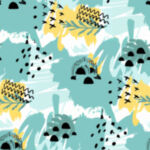
The printed design is of standard complexity, artistic, drawn, and abstract in style. The main colors are deep sea green (41.85%), aqua blue (33.37%), and bold yellow (11.5%). These colors can be combined with solid tones such as black, white, and grey to create stunning contrast. The design is printed on one side by digital textile printing, which creates a crisp and defined finish.
The Fine Water-Repellent Fabric - Storm has a water-repellent finish that makes it water-repellent. Its thin and smooth texture gives it a soft and comfortable feel. The printed design is complex and artistic, composed of drawn and abstract elements that give it a unique style.
The applications and uses of this fabric extend beyond fashion and sport. It is also suitable for shower curtains in homes and hotels where water and moisture resistance are desired. Additionally, it can be used in making bedding to create a relaxing and modern ambiance.
To ensure the durability of the Fine Water-Repellent Fabric - Storm, it is recommended not to bleach it, wash it at a maximum temperature of 40°C, do not dry clean, iron at a cool temperature, and do not tumble dry.
The printing technology used on this fabric is sublimation, which involves printing the design on a sheet of thermal paper and then transferring it to the fabric using heat and pressure. This allows for a highly defined and brilliant print that does not fade or lose color over time.