Close
Click or press [Enter] to view the results
Trends


Printed Fabrics View articles
Telas en Colores Lisos View articles
Telas para Imprimir View articles
Trends
Printed Fabrics View articles
Telas en Colores Lisos View articles
Telas para Imprimir View articles


Elige colores lisos a juego con tu estampado favorito. ¡Selecciona aquí alguno de los colores principales!
| Material: | 97% Polyester, 3% Elastane |
| Width (cm): | 150 |
| Grammage (g/m²): | 209 |
| Pattern: | Drawn, Botanist, Home Decoration, Pictorial florals, Artistic Flowers |
| Features: | Wrinkled, Elastic, Soft |
| Application / Use: | Pants, Cloths, Skirts, Jeans, Shorts |
| Manufacturing Method: | Single-sided digital textile printing, all products are custom-made to order. |
| Care: |
     |
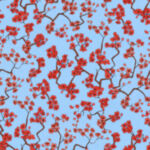
The base fabric is the Bi-elastic Twill - Lisbon, a twill fabric composed mainly of polyester with 3% elastane, which gives it a certain elasticity. With a weight of 209 gr/m2 and a width of 150 cm, this fabric has a rough and elastic texture, combined with a soft feel at the same time. The printed design, created with sublimation technology, stands out for its botanical style and for being composed of floral elements, such as pictorial florals, artistic flowers or cherry blossoms, presenting a main tone of Aqua Blue, combined with Charcoal Red and Garnet Red.
This floral design is ideal for making womens garments or accessories, such as skirts, dresses or trousers. The Bi-elastic Twill - Lisbon is presented as a resistant fabric with a certain elasticity, which makes it a perfect option for making comfortable and flattering garments.
Regarding applications, apart from womens fashion, it can be used for making kitchen towels, cushions, frames and paintings. Likewise, its weight allows its use in the making of household linen such as napkins.
It is important to note that to maintain the quality of the fabric, a series of cares must be followed, such as not bleaching or tumble drying, dry cleaning except trichloroethylene, ironing at cold temperature and washing at a maximum temperature of 30 ºC. This ensures a prolonged useful life of the fabric and prevents the deterioration of its characteristics.
Finally, it is worth mentioning that the printing technology used for the creation of this printed design is sublimation, a process by which the ink is transferred to the fabric by evaporation, providing a high-resolution result and great color sharpness. It is important to note that the fabric is printed on one side by digital textile printing, which guarantees consistent quality and a durable finish.