Close
Click or press [Enter] to view the results
Trends


Printed Fabrics View articles
Telas en Colores Lisos View articles
Telas para Imprimir View articles
Trends
Printed Fabrics View articles
Telas en Colores Lisos View articles
Telas para Imprimir View articles


| Material: | 94% Polyester, 6% Elastane |
| Width (cm): | 150 |
| Grammage (g/m²): | 180 |
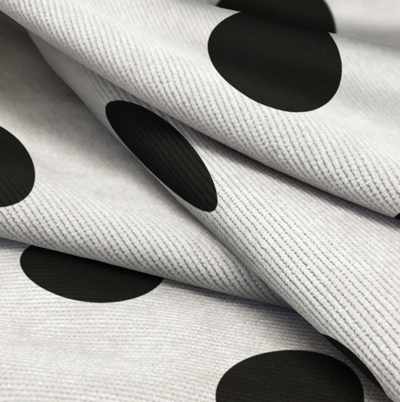
| Pattern: | Moles, Dark |
| Features: | Elastic, Granules |
| Application / Use: | Dresses, Monkeys, T-shirts, Tops, Skirts |
| Manufacturing Method: | Single-sided digital textile printing, all products are custom-made to order. |
| Care: |
     |
| Notices: |
En colores lisos y/o estampados este tejido puede blanquear si se abre en exceso, es ampliamente adquirido por nuestros clientes en productos textiles que no exigen grandes elongaciones. Recomendamos adquirir una muestra para validar que es la textura y acabado que busca. |
The Stretch Knit Crepe Fabric - Riga is a polyester and elastane crepe with a weight of 180 gr/m2 and a width of 150 cm. Its printed design features circles and polka dots in off-white, midnight black, and cloud grey. This design symbolizes elegance and sophistication without sacrificing fun and dynamism. Additionally, when combined with solid colors like black or white, you can achieve a monochromatic look with a touch of originality. It is an elastic and granular fabric to the touch. The fabric is digitally printed with the design on one side only.
The fabrics characteristics are its elasticity and granular texture, making it ideal for fitted and flattering garments. Furthermore, thanks to its composition, it is resistant and durable. Recommended uses for this fabric range from dresses and jumpsuits to knitwear such as cardigans or tops. It is perfect for any season and occasion, from evening looks to more casual daytime outfits.
To keep this fabric in perfect condition, it is recommended not to bleach, not to wash at temperatures above 40ºC, dry cleaning is allowed except for trichloroethylene, iron at a cool temperature, and it can be tumble dried at a reduced temperature.
The printing technology used to manufacture this fabric is sublimation, a method that involves printing inks on paper and then transferring them to the fabric using heat and pressure. This ensures a high-quality and durable print without compromising the softness and appearance of the fabric.