Close
Click or press [Enter] to view the results
Trends


Printed Fabrics View articles
Telas en Colores Lisos View articles
Telas para Imprimir View articles
Trends
Printed Fabrics View articles
Telas en Colores Lisos View articles
Telas para Imprimir View articles


Elige colores lisos a juego con tu estampado favorito. ¡Selecciona aquí alguno de los colores principales!
| Material: | 100% Polyester |
| Width (cm): | 160 |
| Grammage (g/m²): | 260 |
| Pattern: | Watercolor, Painting, Simple, Decorative, Light |
| Features: | Wrinkled, Rigid, Opaque |
| Application / Use: | Racks, Pictures, Cushions, Pants, Toiletry bags |
| Sustainability certificates: | GRS |
| Manufacturing Method: | Single-sided digital textile printing, all products are custom-made to order. |
| Care: |
     |
| Notices: |
Esta referencia de tela está fabricada a partir de botellas de plástico reciclado PET e hilo de poliéster reciclado, por lo que puede presentar pequeñas trazas, hilos o borra dada su naturaleza reciclada y cuya aparición, aunque se de en un % bajo de ocasiones, es totalmente arbitraria e inevitable. También presenta unos indices de encogimiento relevantes que pueden oscilar entre un 4-9 % de encogimiento a lo largo del tejido y un 2% al ancho en función de la pieza. |
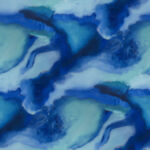
The base fabric is a recycled PET canvas called Dallas. Its composition is 100% polyester, with a weight of 260 gr/m2 and a width of 160cm. The printed design is a mix of different attributes such as abstract watercolor, paint style, and simple complexity. The main colors are multicolored. This design could also be combined with solid tones such as greens, ochres, blues, or reds. It is important to note that the fabric is digitally printed with the design on one side only.
The general characteristics of the base fabric are that it has a rough and rigid texture to the touch, and is visually opaque. On the other hand, the printed design is abstract, artistic, and of simple complexity. Both attributes work together as an eye-catching and interesting decorative proposal. Regarding applications and uses, this fabric is ideal for decorating frames, paintings, cushions, and home textiles in general. In terms of fashion, it can be used in the manufacture of trousers and accessories such as wallets, backpacks, hats, and tote bags, among others.
For the care of this fabric, bleaching should be avoided, and it should be washed at a maximum temperature of 30ºC, not tumble dried at high temperatures, and ironed at a cool temperature. It allows dry cleaning with solvents, which is also important to consider.
Finally, the printing technology used to manufacture this fabric is sublimation (polyester). This means that the design is applied to the fabric through a sublimation process, in which the sublimation ink turns into gas and adheres to the polyester fiber in the fabric. This achieves a print with vibrant and long-lasting tones.