Close
Click or press [Enter] to view the results
Trends


Printed Fabrics View articles
Telas en Colores Lisos View articles
Telas para Imprimir View articles
Trends
Printed Fabrics View articles
Telas en Colores Lisos View articles
Telas para Imprimir View articles


Elige colores lisos a juego con tu estampado favorito. ¡Selecciona aquí alguno de los colores principales!
| Material: | 75% Polyester, 25% Elastane |
| Width (cm): | 150 |
| Grammage (g/m²): | 230 |
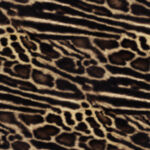
| Pattern: | Cheetah, Cheetah, Simple, Decorative, Dark |
| Features: | Elastic, Chlorine Resistant, Very High UV Protection 50+ |
| Application / Use: | Body, Bikinis, Swimsuit, Jersey, Tights / Leggings |
| Sustainability certificates: | GRS |
| Manufacturing Method: | Single-sided digital textile printing, all products are custom-made to order. |
| Care: |
     |
The Recycled Lycra - Seal fabric, weighing 230 gr/m2, features an ANIMAL PRINT design with a Cheetah motif in shades of Night Black, Mocha Brown, and Coffee Bear Brown, representing the animals fur with a simple decorative style. The texture of this design is skin-like, giving the drawing a very realistic appearance. Possible combinations with this fabric and other solid colors include black, white, brown, beige, or olive green, among others.
Its important to note that this fabric is printed with the stamped design on one side only using digital textile printing. This means it is not a double-sided printed fabric, but rather the printing is done solely on one side. Regarding the general characteristics of the fabric, it is elastic, has a soft touch, and is chlorine-resistant, making it a very suitable fabric for sportswear or swimwear. Furthermore, the printed design features a finish that provides very high UV protection 50+ thanks to the sublimation (polyester) technology used in its printing.
Regarding the applications and uses of the Recycled Lycra - Seal fabric of 230 gr/m2, it is suitable for lingerie, bodysuits, swimsuits, bikinis, leotards, and leggings, among others. Therefore, it is a very versatile fabric, suitable for both sportswear and fashion garments.
As for the care instructions for this fabric, it is important not to bleach it and to wash it at a maximum temperature of 40ºC. It cannot be dry cleaned or tumble dried, and it is recommended to iron at a low temperature.
Finally, regarding the printing technology used for this fabric, sublimation (polyester) is a digital printing process that involves transferring an image from paper or film to a fabric using heat and pressure. In this case, this method is used because Lycra contains elastane, a material that cannot be effectively printed using inkjet or laser technology. Sublimation allows the design to merge with the fabric fibers, resulting in a high-quality and durable image.