Close
Click or press [Enter] to view the results
Trends


Printed Fabrics View articles
Telas en Colores Lisos View articles
Telas para Imprimir View articles
Trends
Printed Fabrics View articles
Telas en Colores Lisos View articles
Telas para Imprimir View articles


Elige colores lisos a juego con tu estampado favorito. ¡Selecciona aquí alguno de los colores principales!
| Material: | 96% Polyester, 4% Elastane |
| Width (cm): | 150 |
| Grammage (g/m²): | 220 |
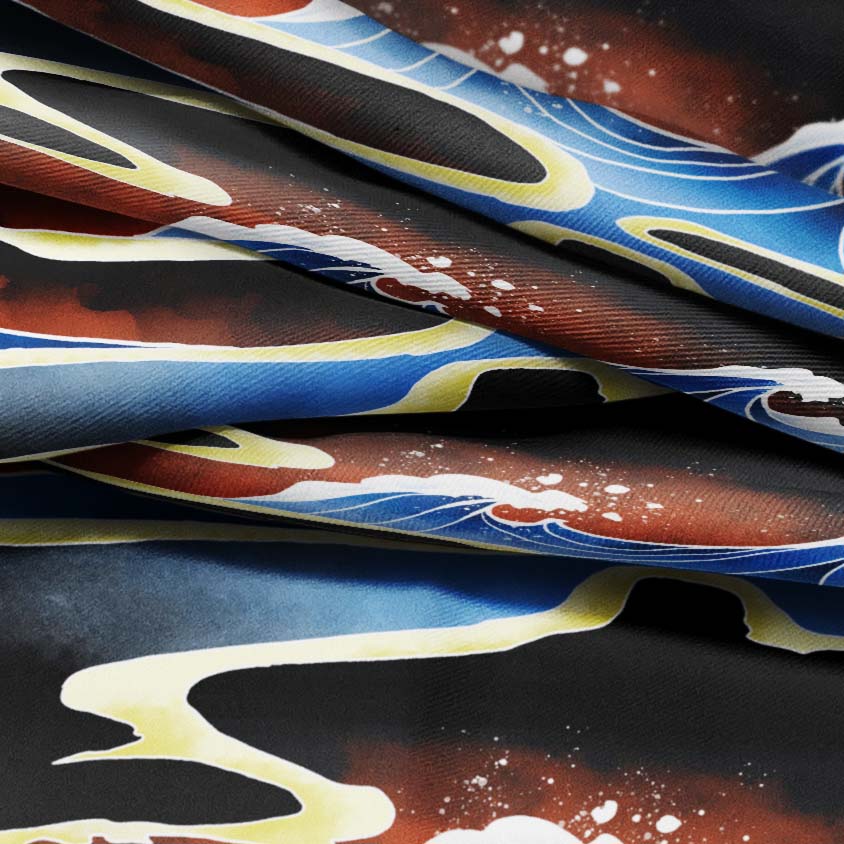
| Pattern: | Maritime Motifs, Waves, Water, Dark |
| Features: | Soft, Thin |
| Application / Use: | Shirts, Skirts, Blouses, Dresses, Handkerchiefs |
| Manufacturing Method: | Single-sided digital textile printing, all products are custom-made to order. |
| Care: |
     |
| Notices: |
Existen diferentes tipos de Sarga disponibles sen nuestra web, este tejido es una Sarga fina de bajo gramaje. Recomendamos adquirir una muestra para validar que es la textura que busca. |
Sarga - Prada fabric is a soft and technical twill composed of 96% polyester and 4% elastane, with a weight of 220 gr/m2 and a width of 150 cm. Its printed design of maritime motifs and waves, in predominantly dark tones such as night black, steel blue and blood brown, combines perfectly with solid colors such as white, ivory and light blue, creating stylish and elegant outfits for different garments such as skirts, shirts, blouses and dresses.
The general characteristics of Sarga - Prada fabric are its soft touch, its thinness and its ability to be used in various fashion garments for both women and men. In addition, its printed design uses sublimation technology on polyester, which gives it digital print quality and high durability even in extreme environments.
Among the applications and uses of Sarga - Prada fabric are fashion pieces for both women and men, especially skirts, shirts, blouses and dresses, and it can also be used for creating scarves and accessories. Its care is simple and requires avoiding bleaching, using maximum temperatures of 30ºC in washing, avoiding tumble drying and ironing only at cold temperatures.
Regarding printing technology, this fabric is manufactured using the sublimation technique on polyester, whereby the ink is converted into vapor and, thanks to the appropriate temperature and pressure, transforms into solid material that penetrates the polyester fibers of the fabric. This printing process allows for more precise and durable designs than those obtained by other printing methods.